About Gyaan Shrinkhala
Nepal’s governance landscape is increasingly shaped by a young population that is highly connected, politically aware, and exposed to global narratives. However, this engagement is largely informal, driven increasingly by social media and built upon weak empirical, analytical and critical foundations given the rote-learning based Nepali school education system.
Gyaan Shrinkhala courses seek to address this lacuna with a short course series on governance issues tailored for Gen Z but open to the general public. There is a two-fold goal. One is translating complex public policy and governance concepts into accessible, experiential learning formats grounded in Nepal’s situated histories and present realities. The other is to instill a curiosity about how governance issues are being framed, understood and implemented that goes beyond everyday “guph.”
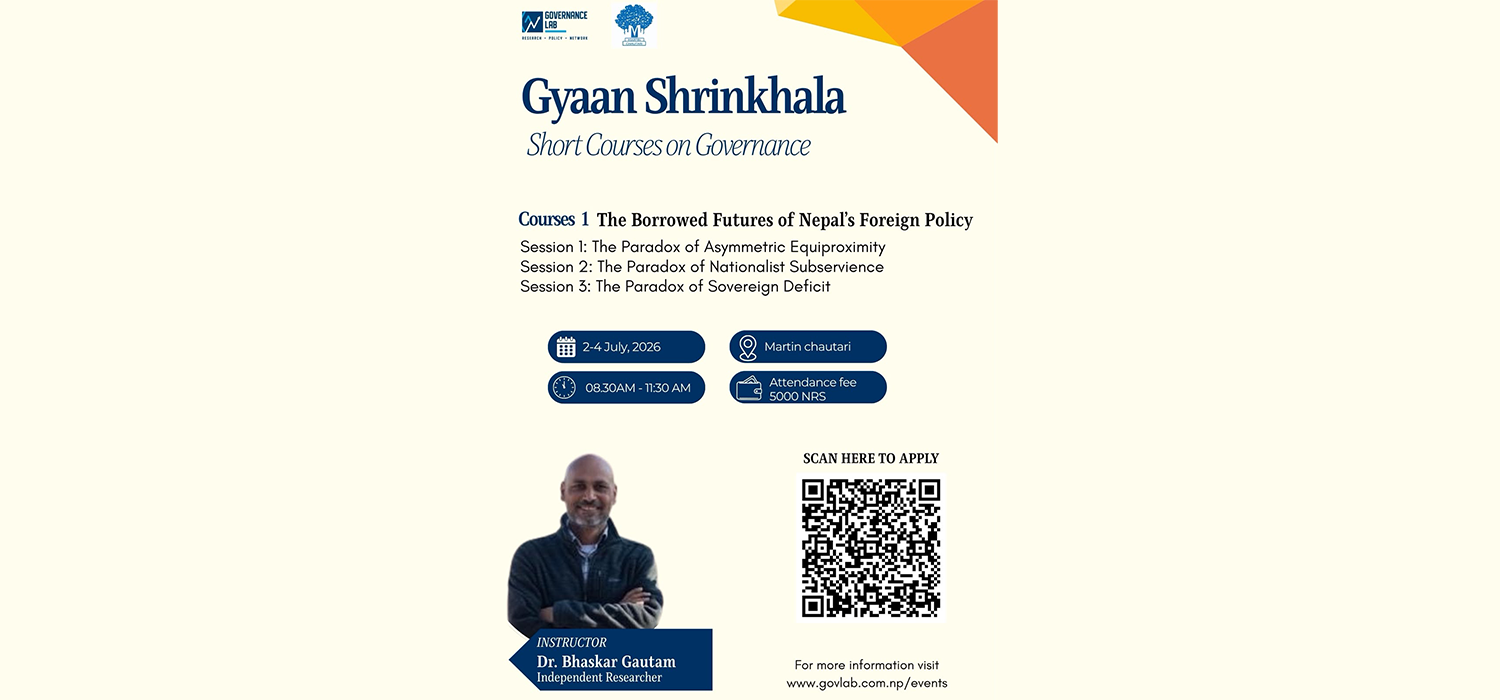
About Gyaan Shrinkhala 101 on The Borrowed Futures of Nepal’s Foreign Policy
Course Instructor: Dr. Bhaskar Gautam
Date: Thursday July 2 – Saturday July 4, 2026.
Time: 8:30 to 11:30am
Moving beyond the strategic default of “equiproximity” or reactive balancing, the course investigates how Nepal’s strategic imagination is frequently outsourced to, or severely constrained by, a competing external trilemma: India’s “neighbourhood first” security architecture, China’s expanding trans-Himalayan connectivity, and the United States’ Indo-Pacific Strategy. Crucially, this course argues that this geopolitical trilemma cannot be understood in isolation from Nepal’s deep-seated economic dependencies. By integrating political economy into traditional strategic analysis, this course on foreign policy examines how these “borrowed futures” are structurally reinforced by two domestic realities:
- The Remittance-Migration Nexus
- Development and Aid Financialization
Session Breakdown
Session 1: The Paradox of Asymmetric Equiproximity: This session deconstructs the doctrine of “equiproximity” by demonstrating how physical geography and trade monopolies render mathematical diplomatic neutrality impossible.
Session 2: The Paradox of Nationalist Subservience: This session bridges macro-geopolitics with micro-domestic polarization, exploring how foreign aid and international compacts are weaponized as domestic political currency.
Session 3: The Paradox of Sovereign Defici: The final session evaluates the machinery of Nepali diplomacy, analyzing how a structural reliance on exporting human capital hollows out the state’s capacity to design a sovereign strategy.
Instructor: Dr. Bhaskar Gautam:
Dr. Bhaskar Gautam is an independent researcher working on the politics and society of Nepal. He has published extensively in journal articles and book chapters on topics such as violence, social movements, and inequalities. In addition to his other works, he has co-authored Courage in Chaos (2015) and co-edited Nepalma Garibiko Bahas (Discourse over Poverty in Nepal, 2004), Maobadi Vidroha: Sasastra Sangrasako Avadhi (Maoist Rebellion: The Period of Armed Struggle, 2007), Maobai Samgarsha: Santipurna Rupantaran (Maoist Struggle: Peaceful Transformation, 2008), and Madhes Vidhrohako Nalibeli (Contours of Madhes Revolt, 2008). His research interests include Nepal’s intellectual history, politics and religion, and social transformation.